Prejudice: How to Recognise It, Challenge It and Build Fairer Everyday Relationships

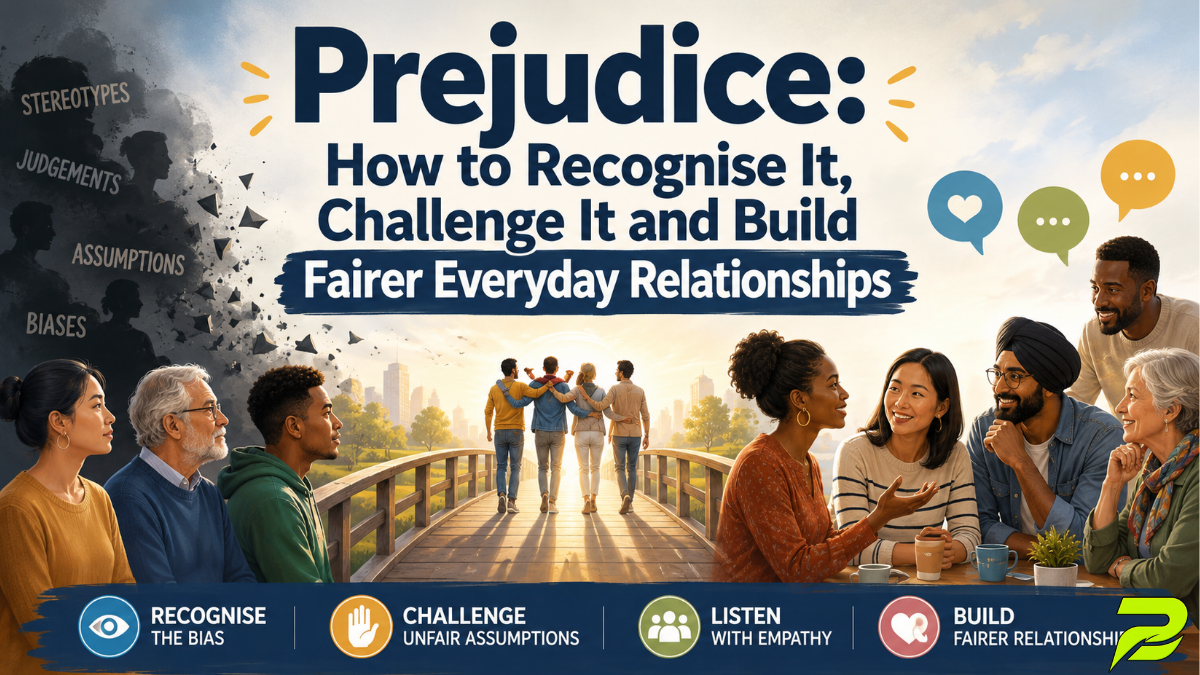
Prejudice can shape the way people are treated long before anyone has taken the time to understand who they actually are. It can appear in a job interview, a classroom, a rented flat, a football stand, a family conversation or even during an ordinary journey on the bus.
Sometimes it is blatant. At other times, it hides behind assumptions, humour, stereotypes or phrases such as “people like that always…”.
Understanding prejudice matters because attitudes can influence decisions, opportunities and relationships. This guide explains what it means, where it comes from, how it differs from discrimination and stereotyping, what UK law says about unfair treatment, and what individuals can realistically do when they encounter it.
Key Takeaways
- Prejudice is a preconceived attitude or judgement about a person or group, often formed without enough accurate information.
- It can relate to race, age, disability, religion, nationality, sex, social class, accent and many other characteristics.
- Stereotyping concerns assumptions, while discrimination involves treatment or behaviour; the three concepts can overlap.
- UK equality law protects people against certain forms of discrimination connected with nine protected characteristics.
- Challenging unfair assumptions usually works best through calm questions, accurate information, fair procedures and consistent behaviour.
What Does Prejudice Actually Mean?
At its simplest, prejudice means forming an opinion about somebody before properly knowing the relevant facts.
The judgement may be negative, although favourable assumptions about a group can also create problems. What matters is that the conclusion is based more heavily on group identity or an existing belief than on the individual person.
Imagine a landlord assuming that a young tenant will automatically be noisy. A manager might assume an older applicant will struggle with new technology. Someone hearing a regional accent might make an immediate judgement about intelligence, education or social background.
None of those conclusions tells you much about the individual.
That is what makes prejudice particularly damaging: people can end up responding to an imaginary version of somebody instead of the real person standing in front of them.
Where Does Prejudice Come From?
People are not born with a complete collection of social assumptions. Many attitudes develop gradually through family influence, friendship groups, media, online communities, cultural experiences and personal encounters.
Learned Beliefs
Children notice how adults speak about other groups. If particular communities are repeatedly discussed suspiciously or mockingly, those messages can become normalised.
The same process happens later in life.
A person who constantly hears negative comments about immigrants, pensioners, teenagers or people receiving benefits may begin accepting those ideas without checking whether they are supported by evidence.
Fear of What Feels Unfamiliar
Humans naturally categorise information because it makes a complicated world easier to process. Problems begin when simple categories become rigid judgements.
Someone who has rarely interacted with people from a particular culture or religion might rely on television, social media or second-hand stories instead.
Personal contact often makes those broad assumptions much harder to maintain.
Group Identity
People tend to feel comfortable around those they consider part of their own group.
That group could be based on nationality, neighbourhood, football club, profession, political outlook, school or social class.
Healthy group identity is not automatically a problem. It becomes troublesome when loyalty to “us” produces hostility or unfair assumptions about “them”.
Prejudice, Stereotyping and Discrimination: What Is the Difference?
These words are often used interchangeably, but they describe different ideas.
A stereotype is a generalised belief about a group.
Prejudice is an attitude or judgement influenced by those beliefs.
Discrimination normally describes unfair treatment or behaviour.
For example, somebody might believe that older workers are less adaptable. That is a stereotype. They may consequently develop a negative attitude towards older applicants. That attitude reflects prejudice. If they reject a suitable candidate specifically because of age, their behaviour may amount to discrimination.
The distinction matters particularly in workplaces because discrimination linked to protected characteristics can have legal consequences.
What Does UK Law Say?
British law does not make every unpleasant opinion illegal. The legal focus is generally on discrimination, harassment and other prohibited treatment rather than simply possessing an opinion.
Under the Equality Act 2010, there are nine protected characteristics: age, disability, gender reassignment, marriage and civil partnership, pregnancy and maternity, race, religion or belief, sex and sexual orientation.
Protection can apply in areas including employment, education, consumer services, public services and housing.
Direct and Indirect Discrimination
Direct discrimination can occur when someone receives less favourable treatment because of a protected characteristic. Acas gives employment guidance explaining that disadvantage might include exclusion from opportunities or circumstances that make someone’s job harder.
Indirect discrimination works differently.
A workplace rule might technically apply to everybody but place people sharing a particular protected characteristic at a significant disadvantage. Acas specifically distinguishes this from direct discrimination in its recruitment guidance.
This is why employers need more than simply saying, “We treat everybody exactly the same.” Sometimes a supposedly neutral procedure can create unequal consequences.
How Prejudice Appears in Everyday British Life
Not every example involves dramatic confrontation. Everyday assumptions can be much quieter.
At Work
Consider two equally qualified applicants arriving for an interview in Birmingham.
One has a traditional British-sounding name while the other has a name the recruiter associates with another ethnic background. If that association affects how their CVs are judged, assumptions have already entered the process before either candidate speaks.
Modern recruitment procedures increasingly use structured scoring precisely because gut instinct can be unreliable.
UK employers are required to follow discrimination law when advertising positions, interviewing candidates and making hiring decisions.
On Public Transport
Anyone regularly travelling through London, Manchester or Glasgow will encounter people from a huge range of backgrounds.
Imagine somebody boarding a packed train and deliberately avoiding sitting beside another passenger because of clothing associated with a particular religion.
There might be no spoken insult. Yet the behaviour may still come from prejudice.
Small acts like this can appear insignificant individually, but repeated experiences can make people feel watched, unwelcome or excluded in places everyone uses.
Accent and Social Class
Britain has an enormous variety of accents, and unfortunately they sometimes attract instant assumptions.
A strong Scouse, Brummie, Geordie, Yorkshire or Glaswegian accent tells you where somebody may have lived or grown up. It does not reliably tell you their intelligence, competence or income.
Yet accent prejudice can affect social interactions and professional situations.
Someone should not need to adopt a polished “corporate” voice before their ideas are taken seriously.
Why Prejudice Can Be Difficult to Recognise in Ourselves
Most people like to believe they judge others fairly.
That makes personal bias uncomfortable to acknowledge.
The useful question is therefore not simply, “Am I prejudiced?” A more practical question is: “Are any of my assumptions affecting how I treat this particular person?”
Suppose you automatically expect a teenager in a hoodie to cause trouble while assuming a middle-aged commuter wearing a suit is trustworthy.
Ask yourself what actual evidence produced those conclusions.
Often, there is none.
Recognising prejudice does not require endless guilt or self-criticism. The useful part is noticing the assumption early enough to prevent it controlling your behaviour.
The Real Impact on Individuals
Repeated unfair judgement can affect considerably more than somebody’s feelings.
A person overlooked for interviews may lose income and career progression. A tenant rejected repeatedly may struggle to secure suitable housing. A pupil stereotyped as troublesome may receive less encouragement at school.
The financial consequences can become substantial.
Imagine somebody earning £32,000 annually who repeatedly misses promotion because decision-makers wrongly assume that having childcare responsibilities means they are less committed. Missing even a £3,000 annual pay rise affects not only today’s salary but pension contributions and future earnings.
That is why prejudice should not be dismissed as merely “people having opinions”.
When attitudes influence decisions, real opportunities can disappear.
How Social Media Can Reinforce Prejudice
Online platforms can broaden people’s understanding of the world, but they can also create extremely narrow information bubbles.
If someone repeatedly watches videos portraying one group negatively, recommendation systems may serve increasingly similar material because it keeps them engaged.
Eventually, unusual or extreme examples can begin feeling typical.
One useful habit is deliberately checking the source.
Is the clip representative? Has important context been removed? Is the headline designed to inform you or provoke anger? Can the claim be verified through reliable reporting or original data?
A thirty-second video rarely provides enough information to judge millions of people.
How to Challenge Prejudice Without Turning Every Conversation Into an Argument
Confrontation sometimes becomes necessary, particularly when somebody is being targeted directly. But many everyday situations respond better to questions.
If a colleague says, “Those people never want to work,” asking, “What makes you think that’s true?” forces the assumption into the open.
You can then examine evidence rather than trading insults.
Another effective question is: “Would you make the same judgement if this person came from a different group?”
In workplaces, schools and organisations, systems also matter. Structured interviews, transparent pay bands, written disciplinary procedures and clear complaint processes reduce opportunities for personal assumptions to influence major decisions.
If somebody believes they have experienced workplace discrimination, Acas advises raising the matter with the employer and following any relevant discrimination complaint procedure.
Why Contact Between Different Groups Matters
It is much easier to maintain sweeping assumptions about people you rarely meet.
Real relationships introduce complexity.
The colleague you originally viewed as “very different” may support the same football club. The neighbour whose religion you know little about might share your obsession with gardening. The pensioner you assumed disliked technology may be better with an iPhone than you are.
None of this means differences vanish.
It means individuals stop being reduced to one label.
That is one of the strongest everyday antidotes to prejudice: replacing abstract assumptions with genuine human knowledge.
Conclusion
Prejudice begins with premature judgement, but its consequences can extend into employment, education, housing, friendships and ordinary public life.
The most useful response is not pretending we never make assumptions. It is learning to recognise when assumptions are replacing evidence.
British society contains enormous differences in culture, class, religion, accent, age and life experience. Those differences inevitably shape how people see the world, but they do not need to determine how fairly we treat one another.
Question stereotypes. Judge individuals on relevant evidence. Speak up when unfair behaviour crosses a line. And where decisions affect jobs, services or opportunities, use transparent processes rather than instinct alone.
Those habits will not eliminate prejudice overnight, but they make unfair assumptions considerably less powerful.
Frequently Asked Questions
What is prejudice in simple terms?
Prejudice is a pre-formed judgement about a person or group that is not based on sufficient individual evidence. It often develops from stereotypes, cultural messages, fear or limited personal experience.
Is prejudice the same as discrimination?
No. Prejudice is mainly an attitude, while discrimination concerns unfair treatment or behaviour. A prejudiced belief can contribute to discriminatory action, but the terms describe different stages of the problem.
Is prejudice illegal in the UK?
Having a prejudiced opinion is not automatically illegal, but discriminatory treatment connected with protected characteristics can breach the Equality Act 2010. The circumstances and type of behaviour determine whether legal protection applies.
What are the nine protected characteristics in the UK?
They are age, disability, gender reassignment, marriage and civil partnership, pregnancy and maternity, race, religion or belief, sex and sexual orientation. These characteristics receive legal protection under the Equality Act 2010.
How can I reduce prejudice in my own thinking?
Start by questioning automatic assumptions and judging people using relevant individual evidence. Meeting people outside your usual social circles, checking unreliable claims and challenging stereotypes can also weaken ingrained biases.