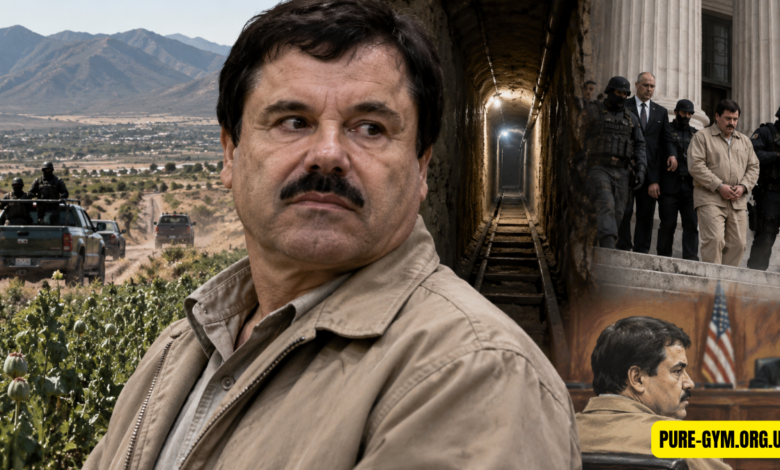
Joaquín Archivaldo Guzmán Loera became one of the most recognizable figures in the history of organized crime, but the popular image of a single criminal mastermind can obscure what made his career significant. His power came from an international trafficking organization capable of moving enormous quantities of narcotics, laundering billions of dollars, corrupting officials, and using systematic violence to protect routes into the United States.
His story also contains events that sound almost fictional: two prison escapes, sophisticated underground tunnels, years spent as an international fugitive, extradition to New York, and a federal trial that exposed the mechanics of the Sinaloa Cartel. Yet focusing only on the spectacle misses the larger story. Guzmán mattered because the organization surrounding him was bigger, more adaptable, and ultimately more durable than the man himself.
How Joaquín Guzmán rose from rural Sinaloa to cartel leadership
Guzmán was born in 1957 and grew up in the mountainous region of Sinaloa, a Mexican state with a long history of marijuana and opium-poppy cultivation. Organized crime networks in this region developed through family relationships and small farming communities before growing into increasingly sophisticated trafficking operations.
He entered the drug trade while relatively young. InSight Crime traces his early career through the network of trafficker Pedro Avilés and later the organizations that developed around Miguel Ángel Félix Gallardo and the Guadalajara Cartel. By the 1980s, Mexican groups had become essential intermediaries for Colombian cocaine organizations shipping drugs north toward the American market.
Guzmán gained a reputation for moving shipments quickly. The Justice Department says that from the mid-1980s until his 1993 arrest, he operated at a mid-level within the emerging Sinaloa organization and acquired another nickname, “El Rápido,” because of the speed with which he transported drugs from Mexico into the United States.
After older trafficking structures fractured, Guzmán and partners including Ismael “El Mayo” Zambada built one of Mexico’s dominant criminal organizations. Their advantage wasn’t some single brilliant trick. It was logistics: access to suppliers, transportation corridors, corrupt connections, distribution cells, money-moving systems, and armed enforcement.
That distinction matters. Movies tend to turn cartel history into biographies of charismatic bosses. Real trafficking organizations work more like illegal multinational supply chains.
Why El Chapo became much more famous than other cartel bosses
Plenty of traffickers accumulated extraordinary power without becoming globally recognizable. Guzmán’s fame came partly from the scale of his operation, but his ability to repeatedly evade authorities transformed him into a public spectacle.
His first major arrest came in 1993. He was imprisoned in Mexico and received a 20-year sentence, but on January 19, 2001, he escaped from federal prison. U.S. authorities later described him as leaving concealed in a laundry cart. Once free, he spent more than 13 years rebuilding his position while avoiding capture.
Mexican authorities finally arrested him again on February 22, 2014, at a resort hotel in Mazatlán, Sinaloa. That should have ended the fugitive chapter.
It didn’t.
On July 11, 2015, Guzmán disappeared from the Altiplano maximum-security prison through an opening beneath the shower area of his cell. The passage extended roughly 1.5 kilometers and incorporated lighting, ventilation, and a rail system. Court documents later described conspirators obtaining property near the prison and using a GPS-enabled watch to help determine the precise location needed for the tunnel.
This is where many retellings become too enamored with the engineering. The more important question is how an organization could coordinate such a project beneath a supposedly secure federal facility. The escape became a symbol not merely of one prisoner’s ingenuity but of the extraordinary resources and institutional weaknesses surrounding Mexico’s cartel problem.
How big was the Sinaloa trafficking operation?
The evidence presented in the United States showed an organization operating at industrial scale.
Federal prosecutors said the cartel transported tens of thousands of kilograms of narcotics from Central and South America for distribution across the United States. Its methods included aircraft, fishing vessels, submarines, trains containing secret compartments, vehicles, and underground cross-border tunnels. Wholesale distribution reached cities including Los Angeles, Chicago, Atlanta, Miami, and New York.
Those routes were backed by violence. Prosecutors presented evidence that armed enforcers, commonly called sicarios, protected the cartel’s territory and eliminated perceived threats. Drug revenue generated in American markets was then moved or laundered back toward Mexico.
That network explains why simply arresting a kingpin rarely destroys a mature trafficking organization. Suppliers, transportation specialists, distributors, financiers, corrupt facilitators, and regional commanders can continue operating even after the person at the top disappears.
The 2016 capture that finally ended his years on the run
Guzmán’s second period as a fugitive lasted roughly six months.
On January 8, 2016, Mexican forces located him in Los Mochis, Sinaloa. According to the DEA Museum’s account, a Mexican Navy special-operations unit raided a house where he was staying. Guzmán initially escaped through another hidden tunnel and emerged through a manhole with a bodyguard before the pair attempted to flee. Authorities captured them before they could get away.
This time, Mexico faced intense pressure to prevent another escape.
Instead of leaving him indefinitely within the Mexican prison system, the government approved his extradition. On January 19, 2017, he was transferred to the United States and landed at Long Island MacArthur Airport in New York. At that point, six separate U.S. indictments were pending against him.
The endless fugitive story was effectively over.
What happened during the U.S. trial?
Guzmán went on trial in federal court in Brooklyn before U.S. District Judge Brian Cogan. The proceeding lasted approximately 12 weeks and offered an unusually detailed view of the cartel’s internal operations through testimony, intercepted communications, financial evidence, and cooperating witnesses.
On February 12, 2019, the jury convicted him on all 10 counts in the superseding indictment. Those convictions included operating a continuing criminal enterprise, narcotics trafficking, firearms offenses connected to drug crimes, and money laundering conspiracy. The continuing-criminal-enterprise charge incorporated numerous drug violations and a murder conspiracy.
His punishment was not simply a conventional lengthy prison term. On July 17, 2019, Judge Cogan sentenced Guzmán to life in federal prison plus an additional consecutive 30 years. The court also ordered a $12.6 billion forfeiture judgment representing proceeds attributed to the trafficking enterprise.
For anyone wondering whether an eventual parole date exists, the practical answer is no. The life sentence for the continuing criminal enterprise was imposed without the possibility of parole.
Did his imprisonment actually destroy the Sinaloa Cartel?
No, and this is probably the most important part of the story.
The organization did not disappear after its famous leader entered U.S. custody. Leadership shifted among established figures and members of the next generation. Guzmán’s sons—often collectively referred to as the Chapitos—became major actors within the organization alongside competing factions.
The continuing U.S. prosecutions illustrate that evolution. Ovidio Guzmán López pleaded guilty to federal drug charges in Chicago in July 2025. His brother Joaquín Guzmán López entered guilty pleas to federal charges in December 2025.
Meanwhile, longtime Sinaloa co-founder Ismael Zambada was eventually taken into U.S. custody and, in July 2026, received a life sentence.
That succession tells us far more about cartel power than the mythology surrounding any individual boss. Remove one leader and the market does not disappear. Profits, trafficking corridors, criminal partnerships, and consumer demand create incentives for someone else to fill the vacancy.
The myth versus what the court record shows
Popular culture sometimes turns major traffickers into antiheroes—men portrayed as rebellious entrepreneurs who outsmart governments. That framing is entertaining, but it strips away the cost that made the enterprise profitable.
The federal case documented large-scale narcotics trafficking, money laundering, armed enforcement, and conspiracies involving serious violence. The cartel’s logistical sophistication is worth understanding precisely because it demonstrates how organized crime can function across international borders. It shouldn’t be confused with admiration.
The prison escapes are remarkable stories. The billion-dollar business is remarkable. So is the ability to coordinate ships, aircraft, tunnels, warehouses, distributors, and financial networks across countries.
But none of those achievements existed separately from coercion and violence.
Frequently Asked Questions
Where is El Chapo now?
He is serving his federal sentence at the maximum-security federal complex in Florence, Colorado. Recent reporting continues to identify him as imprisoned at the federal Supermax facility there, following his 2019 life-plus-30-years sentence.
How many times did Joaquín Guzmán escape from prison?
He escaped twice from Mexican prisons. The first escape occurred in January 2001, reportedly through a laundry-cart operation, while the second happened in July 2015 through the tunnel beneath his Altiplano prison cell.
How long is Joaquín Guzmán’s prison sentence?
His sentence is life imprisonment plus 30 consecutive years. A U.S. federal judge imposed it on July 17, 2019, and also ordered $12.6 billion in forfeiture.
Is the Sinaloa Cartel still active after Guzmán went to prison?
Yes. The organization survived his removal and continued under other leaders and competing factions, including figures associated with his sons. Federal cases involving those successors continued well into 2025 and 2026.
How did Joaquín Guzmán get so powerful?
He built power through logistics, trafficking alliances, access to U.S. distribution networks, corruption, and violent enforcement. Evidence at his federal trial showed narcotics moving through aircraft, boats, trains, tunnels, and other transportation systems into major American markets.
Joaquín Guzmán’s life makes more sense when viewed as the story of a criminal network rather than an untouchable individual. His escapes made him famous, but the deeper lesson is how a sophisticated trafficking organization can survive arrests, leadership changes, and enormous law-enforcement pressure. The kingpin eventually ended up behind bars; the economic and organizational machinery that produced his power proved much harder to eliminate.