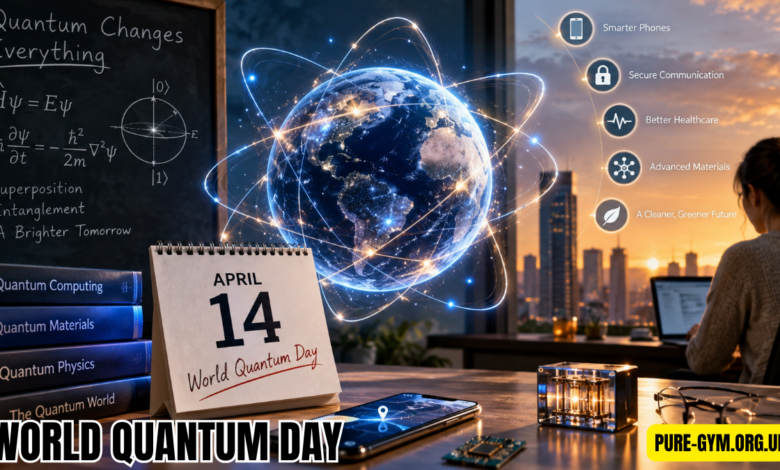
World Quantum Day: Why April 14 Matters and How Quantum Science Already Shapes Your Life

Quantum physics has a reputation problem. Mention it in conversation and most people picture impossible equations, particles doing bizarre things, or computers that somehow solve everything instantly.
That makes World Quantum Day surprisingly useful. Celebrated every year on April 14, the event isn’t meant only for physicists working in university laboratories. Its broader purpose is to make quantum science understandable to students, teachers, businesses, policymakers, and people who simply want to know why this strange branch of physics keeps appearing in conversations about computing, cybersecurity, medicine, GPS, and the future of technology.
The date itself contains a physics reference, and the technology behind the celebration is much closer to everyday American life than most people realize.
Why World Quantum Day Happens on April 14
April 14 — written as 4/14 in the United States — was chosen because 4.14 represents the rounded first digits of Planck’s constant when expressed in electron volt-seconds.
The actual value is approximately:
4.1356677 × 10⁻¹⁵ eV·s
Planck’s constant is one of the fundamental constants of quantum physics. It connects the energy of a photon with its frequency and appears throughout quantum mechanics. The official organizers deliberately chose 4/14 as an easy-to-remember reference to that number.
The initiative was launched on April 14, 2021, with the first full global celebration taking place on April 14, 2022. It operates as a decentralized international effort rather than a single conference controlled from one location. Universities, research laboratories, schools, museums, technology companies, educators, and scientific organizations can organize their own lectures, demonstrations, exhibitions, lab visits, workshops, and public discussions.
That decentralized structure is one of its strongest features. You don’t need access to a national laboratory to participate.
Quantum Physics Isn’t Just About Quantum Computers
Public discussion tends to reduce the entire quantum field to one subject: quantum computing.
That’s a mistake.
Quantum computing may become one of the most important applications of quantum information science, but quantum mechanics has already been supporting modern technology for decades.
Lasers rely on quantum principles. Semiconductor electronics ultimately depend on our understanding of quantum behavior in materials. MRI technology uses quantum properties associated with atomic nuclei. Atomic clocks exploit precise transitions between atomic energy states.
Even the blue location dot moving across your smartphone map has quantum physics behind it.
GPS satellites carry atomic clocks because positioning requires extremely accurate timing. A GPS receiver determines location using signals from multiple satellites, and tiny timing errors can become large positioning errors because those signals travel at the speed of light. NIST notes that an error of just 100 nanoseconds could create a positioning error of roughly 30 meters, or nearly 100 feet.
So if you’ve used Google Maps to find a restaurant, tracked a delivery driver, flown on a commercial aircraft, or relied on precise telecommunications networks, you’ve already benefited from technologies rooted in quantum science.
That’s more interesting than saying quantum technology is something we’ll have “someday.”
Parts of it are already here.
What Makes Quantum Mechanics So Different?
Classical physics does an excellent job describing much of the world we directly experience: cars moving down highways, baseballs traveling through the air, planets orbiting stars.
At atomic and subatomic scales, nature behaves differently.
Quantum systems can exist in combinations of possible states known as superpositions. Particles can become entangled, producing correlations between their quantum states that cannot be explained using ordinary classical assumptions. Quantum objects also display wave-like and particle-like behavior depending on how experiments are performed.
These ideas sound bizarre because human intuition developed around objects large enough to behave classically.
Quantum mechanics isn’t strange because scientists intentionally made it complicated. It’s strange because experiments repeatedly show that microscopic nature actually works this way.
That distinction matters.
The subject isn’t philosophy pretending to be physics. Quantum theory became one of the foundations of modern technology precisely because its predictions work extraordinarily well.
The First and Second Quantum Revolutions
A useful way to understand the field is to separate its technological history into two broad stages.
The first quantum revolution came from understanding quantum mechanics well enough to build technologies based on quantum properties of materials and atoms. That scientific foundation contributed to technologies including semiconductors, lasers, atomic clocks, modern electronics, and medical imaging.
The emerging second quantum revolution goes a step further. Instead of merely relying on quantum effects, researchers are learning to deliberately control individual quantum states.
That is driving three especially important areas:
- Quantum computing, where quantum bits, or qubits, could handle certain specialized problems differently from classical computers.
- Quantum sensing, where extremely sensitive quantum systems could improve measurements of time, magnetic fields, gravity, motion, and other physical quantities.
- Quantum communications and networking, where quantum properties may enable new communication and security capabilities.
The U.S. National Quantum Initiative describes computing, networking, and sensing as major technology areas being developed through quantum information science.
The key phrase is specialized problems.
A quantum computer is not simply a super-fast laptop. Most guides get this wrong by implying that quantum machines will replace conventional computers. Your future email, spreadsheet, web browser, and video game do not suddenly need qubits.
The potential advantage appears in particular classes of computation where quantum algorithms and sufficiently capable hardware can exploit quantum behavior in useful ways.
Why the United States Takes Quantum Technology Seriously
Quantum science isn’t only an academic research topic in the United States. It has become part of economic, technology, workforce, and national-security planning.
Congress established the National Quantum Initiative in 2018 through the National Quantum Initiative Act. The effort coordinates quantum information science activities across federal agencies, including work associated with the National Science Foundation, Department of Energy, and National Institute of Standards and Technology. The initiative currently includes national QIS research centers as well as industry participation.
The CHIPS and Science Act of 2022 also expanded attention to areas such as quantum networking, research access, standards, and quantum information science education.
There’s a practical reason for this investment.
Countries that develop useful quantum technologies could gain advantages in scientific research, advanced manufacturing, sensing, communications, materials development, cybersecurity, and other strategically important industries.
At the same time, hype needs to be kept under control. Quantum computers are improving, but building large, fault-tolerant systems remains an enormous engineering challenge. Qubits are fragile, errors are difficult to control, and useful quantum advantage is highly problem-dependent.
Celebrating quantum science should mean understanding both the opportunity and the difficulty.
Why 2025 Became an Especially Important Year for Quantum Science
The global celebration received unusually strong attention in 2025 because the United Nations General Assembly proclaimed 2025 the International Year of Quantum Science and Technology, with UNESCO serving as the lead agency.
The year marked roughly a century since foundational developments that established modern quantum mechanics. UNESCO used the initiative to promote public understanding, education, international scientific cooperation, sustainability, and broader access to quantum research and technology.
UNESCO’s effort also raised a less glamorous but important issue: the risk of a quantum divide.
If advanced quantum infrastructure, education, funding, and expertise become concentrated in only a few wealthy countries or institutions, much of the world could struggle to participate in the technology’s development. UNESCO specifically emphasized capacity building, education, and wider participation as part of its program.
That conversation needs to continue beyond a single commemorative year.
What Can Students Actually Do on April 14?
You don’t need to understand advanced linear algebra before exploring quantum science.
For a middle-school or high-school student, the best first step is understanding concepts such as photons, atoms, probability, superposition, measurement, and the difference between classical and quantum information. Trying to begin with graduate-level equations is usually a fast way to kill someone’s interest.
Teachers can use classroom demonstrations, videos, simple experiments with light, interactive simulations, and lessons connecting quantum ideas to technology students already recognize.
The National Science Foundation supports quantum education efforts extending from K-12 classrooms through undergraduate research and workforce development. Programs include educator resources, student learning opportunities, internships, research experiences, and initiatives aimed at preparing a broader U.S. quantum workforce.
A high-school student doesn’t need a million-dollar laboratory to start.
A laptop, free educational resources, basic Python, solid algebra, and genuine curiosity can provide a much better introduction than memorizing jargon about qubits.
Students who decide to go deeper can eventually study physics, electrical engineering, computer science, mathematics, materials science, photonics, or related fields. Quantum technology is multidisciplinary; there isn’t one mandatory career route.
Could Quantum Technology Affect Cybersecurity?
Yes, and this is one of the reasons governments and security professionals pay close attention to quantum computing.
Large, sufficiently capable fault-tolerant quantum computers could threaten some public-key cryptographic systems that protect digital communications today. That doesn’t mean somebody with a small experimental quantum processor can suddenly break your bank account encryption.
The relevant machines would need capabilities far beyond most present systems.
Still, cryptographic migration takes years, which is why organizations are already working on post-quantum cryptography — classical cryptographic algorithms designed to resist attacks from both conventional and future quantum computers.
This is a good example of why quantum literacy matters before the hardware reaches its theoretical potential. Infrastructure decisions sometimes need to be made long before the threat fully arrives.
Five Common Questions People Ask
What date is quantum day every year?
It is celebrated annually on April 14. The date 4/14 references approximately 4.14, the opening digits of Planck’s constant when expressed in electron volt-seconds.
Who started it?
The initiative was created by an international group of quantum scientists and launched on April 14, 2021. The first worldwide celebration followed in 2022, with participation designed to be open to researchers, educators, companies, museums, artists, schools, and the general public.
Do I need to know physics to participate?
No. Many activities are specifically designed for beginners and students. Public talks, school lessons, simulations, museum activities, videos, and introductory workshops can explain quantum ideas without requiring university-level mathematics.
Is quantum computing already useful in everyday life?
Quantum computers are still developing and are not replacing ordinary computers, but quantum physics already supports everyday technologies including lasers, electronics, MRI systems, and the atomic-clock technology used by GPS.
What should I learn if I want a quantum career?
Start with mathematics, physics, programming, or engineering and then specialize based on your interests. U.S. quantum workforce programs increasingly span physics, computer science, electrical engineering, materials research, sensing, photonics, and technical education rather than treating quantum science as a physics-only career.
Quantum science deserves attention because it sits in an unusual position: it is both one of humanity’s deepest explanations of nature and the foundation of technologies people use without thinking about them. April 14 works best when it makes that connection visible. The real goal shouldn’t be to convince everyone to become a quantum physicist; it should be to make quantum technology understandable enough that people can participate intelligently in decisions about where it goes next.