Wordle Hint Today Mashable: Clues, Strategy, and Today’s Answer for September 14, 2026

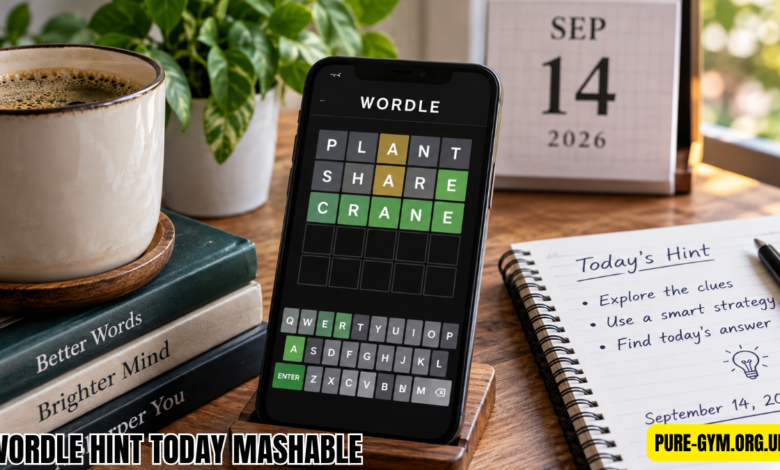
If you searched wordle hint today mashable, you probably don’t want someone to immediately throw the answer at you. You want just enough help to rescue a shaky third or fourth guess without ruining the satisfaction of solving the puzzle yourself.
For Monday, September 14, 2026, the New York Times Wordle is puzzle #1,913. Today’s solution is a familiar everyday word, but the letter pattern can send you toward several plausible alternatives if your opening guess reveals only one or two useful letters. Current puzzle reports and player results confirm the same solution for #1,913.
Below, the clues move from gentle to increasingly revealing. Stop as soon as something clicks.
Today’s Wordle Hints for September 14, 2026
Here’s the lightest clue first:
Think about what you might do after washing your hair, brushing your teeth, or cleaning soap from a plate.
Still stuck? The word describes removing something such as soap, shampoo, dirt, or residue using water or another liquid.
The answer contains five different letters, so you don’t have to worry about a double letter today.
There are two vowels in the word.
The first letter is R.
The word has only one syllable.
Another useful sound clue: it rhymes closely with words such as since and mince.
Those clues are consistent with published September 14 puzzle information, which describes the answer as a five-letter washing-related word beginning with R and containing no repeated letters.
If you’re still trying to protect your streak, don’t scroll to the answer yet. A good next move is to work with the pattern you already have rather than randomly cycling through possible five-letter words.
What Should You Guess If You Know the Word Starts With R?
An opening R narrows things down, but not nearly enough on its own. Words such as RAISE, ROUSE, RIDGE, RIVET, RINSE, RISKY, ROAST, and ROUND all begin with the same letter while testing very different combinations.
That is why I wouldn’t waste a guess merely trying another R-word. Your second or third guess should give you new information.
Suppose your board shows:
R _ _ _ E
At that point, test common middle consonants and vowels. If S, N, and I are still available, they deserve attention because they combine naturally in several English words. A player in today’s Wordle discussion, for example, went from CRANE to NURSE before reaching the solution on guess three. Another began with AROSE and solved the puzzle on the second attempt.
Those examples show why information matters more than chasing a lucky answer. A guess that tests four or five useful letters can turn a messy board into a nearly forced solution.
Why People Search Wordle Hint Today Mashable Instead of the Answer
There is a real difference between asking for a Wordle answer and asking for a hint.
A direct answer ends the game. A properly staged hint keeps the puzzle alive.
Mashable’s recent Wordle coverage follows that idea by gradually increasing the amount of information it gives readers. Its daily format typically starts with a meaning-based clue, then addresses repeated letters, reveals the starting letter, and finally places the solution farther down the page for people who genuinely want it. Recent Mashable Wordle pages use exactly that type of spoiler progression.
That approach makes sense. If you have already spent four guesses narrowing the board to something like R I _ S E, you probably need one tiny push, not somebody yelling the solution.
I think many Wordle guides get this wrong. Giving the first letter and definition in the opening sentence barely counts as a hint. The best help lets the reader decide how much information to reveal.
Today’s Answer — Spoiler Warning
This is the point where the complete September 14 answer appears.
If you still have guesses left, go back to the earlier clues first.
The answer to Wordle #1,913 is:
RINSE
Current September 14 puzzle coverage confirms RINSE as the answer, and player result threads for puzzle #1,913 show the same final green row.
RINSE is a straightforward word once you see it. As a verb, it means washing something briefly or removing soap, dirt, or another substance with clean liquid. You might rinse shampoo from your hair, rinse dishes after washing them, or rinse your mouth after using mouthwash.
The difficulty is less about vocabulary and more about reaching the particular letter combination before your six guesses run out.
Why RINSE Can Be Trickier Than It Looks
RINSE uses common letters, which sounds helpful. The problem is that common letters also create lots of competing possibilities.
If you discover the ending -SE, your brain may jump toward words such as HOUSE, MOOSE, PROSE, CHOSE, or GUISE depending on the letters still available. If you uncover R-I early, words including RIVER, RIDGE, RIFLE, RIGHT, and RISKY can pull you in completely different directions.
Today’s player results demonstrate the issue nicely. One solver used RIGHT, then RISEN, before finding RINSE. Another went from PARSE to ROUSE and finally RINSE. A third moved through STALE-style letter testing before getting there.
The lesson is simple: don’t become emotionally attached to the first pattern you notice.
Wordle punishes tunnel vision more than weak vocabulary.
A Better Way to Use Your First Three Wordle Guesses
I prefer opening words that reveal information instead of trying to hit the jackpot in one move.
A word such as RAISE is especially relevant to today’s puzzle because it tests five common letters and immediately checks three vowels. In fact, one reported player who opened with RAISE had enough information to solve RINSE on guess two.
That doesn’t mean RAISE will always be the perfect starter. No opener guarantees a good board. The more important rule is to avoid spending your second guess repeating gray letters unless there is a strong reason.
If your first attempt gives you almost nothing, the second word should ideally test four or five fresh characters.
For example, imagine starting with AUDIO and learning only that I is present but misplaced. Guessing something like LIGHT next could test four new consonants while relocating I. Guessing another vowel-heavy word would probably teach you less.
By guess three, start thinking about actual structures rather than raw letter frequency. Look for familiar endings such as -ER, -LY, -CH, -ST, -SE, and -NT, but keep unusual placements open until the board rules them out.
Gray Letters Are More Valuable Than Most Players Think
A green square feels great, but a row full of gray letters can be surprisingly useful.
Five gray tiles have eliminated five possibilities from every remaining position. That can wipe out huge groups of candidate words immediately.
The mistake is treating a failed guess as wasted.
Say you tried CLOUD and every letter turned gray. You have just learned that C, L, O, U, and D cannot appear in the answer. Your next guess can aggressively test letters such as A, E, I, R, S, T, and N rather than circling around the same alphabet.
Yellow tiles deserve careful attention too. A yellow letter tells you two things at once: the character belongs somewhere in the answer, and the position you just tried is wrong.
That second part is easy to forget.
Does Wordle Change at Midnight?
Yes. Wordle is a daily puzzle, so checking the date matters when you look for clues online. Search results can continue showing yesterday’s hint page even after a new puzzle is live.
That matters especially around midnight and when reading websites published in different time zones. On September 13, 2026, for example, the answer was FOCUS, while September 12 was NIFTY. The September 14 puzzle advanced to #1,913 with RINSE.
Before trusting a hint page, check both the displayed date and puzzle number.
Where Wordle Came From
Wordle began as a project created by software engineer Josh Wardle for his partner before growing into a global daily puzzle phenomenon. The concept stayed wonderfully simple: guess one five-letter word in no more than six attempts, using colored feedback after each guess to work out what belongs where. Mashable’s continuing Wordle coverage also traces the game back to Wardle and notes the many spin-offs that followed its rise.
Part of its staying power is that one puzzle can take two minutes on an easy day and fifteen frustrating minutes on a bad one.
There’s no giant tutorial, complicated leveling system, or $9.99 bundle of extra guesses. You get six rows and your own vocabulary.
That restraint is probably Wordle’s smartest design decision.
Five Quick Wordle FAQs
what is the Wordle today September 14 2026?
The September 14, 2026 Wordle answer is RINSE, and the puzzle number is #1,913. If you want to solve it rather than reveal it, the safest clue is to think about removing soap or residue using water.
does today’s Wordle have a double letter?
No. RINSE uses five different letters: R, I, N, S, and E. That means testing duplicate letters early would provide less information for this particular puzzle.
what letter does today’s Wordle start with?
Today’s solution begins with R. If you know that but still have several guesses available, test new vowels and high-frequency consonants instead of guessing random R-words.
how many guesses do you get in Wordle?
You get six attempts to identify the five-letter answer. Green means the correct letter is in the correct position, yellow means the letter is present but misplaced, and gray means that letter does not belong in the solution based on the game’s letter-count rules.
is Mashable’s Wordle hint the same as the NYT answer?
Mashable provides clues and coverage for the daily New York Times Wordle rather than running a separate daily Wordle answer. Its recent hint pages typically reveal information progressively before showing the complete solution.
Wordle is at its best when a hint gets you unstuck without finishing the puzzle for you. For September 14, RINSE is a good example: ordinary vocabulary, common letters, but enough competing patterns to make a careless third or fourth guess expensive. Use the smallest clue you need, protect the six-row challenge, and save the full answer reveal for the moment you genuinely run out of ideas.