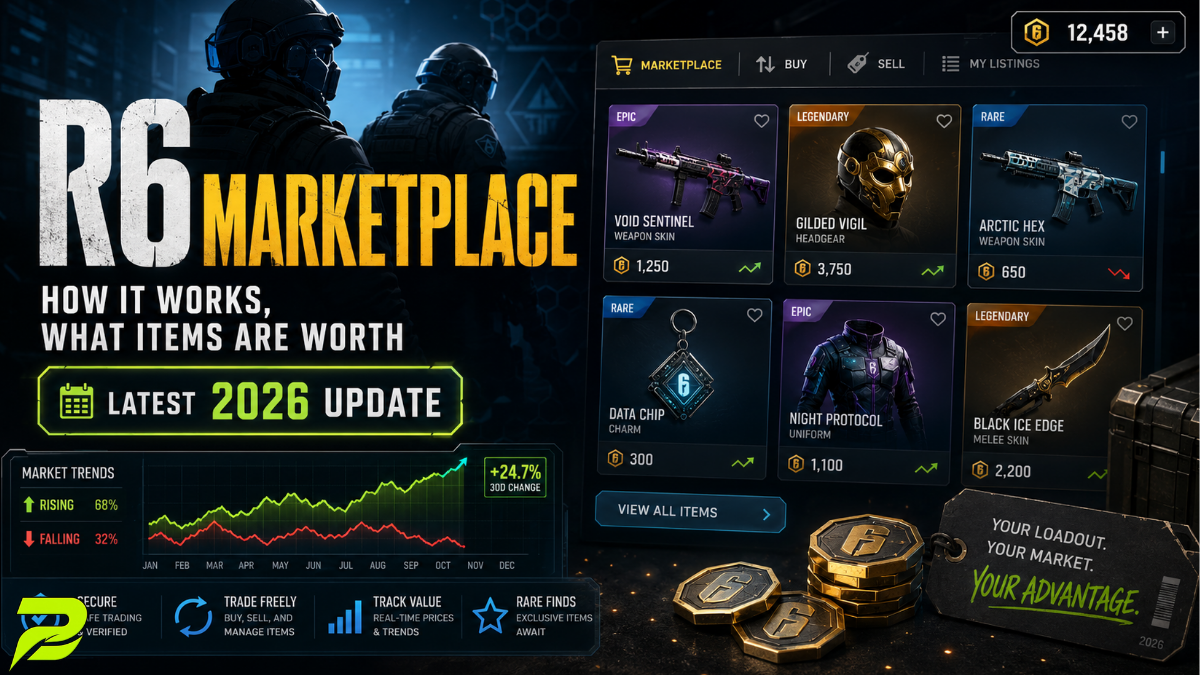
If you have played Rainbow Six Siege for any length of time, there is a fair chance your inventory contains cosmetics you barely remember unlocking. At the same time, there is probably one old weapon skin, attachment skin or headgear you wish you had picked up when it was originally available.
That gap between unwanted items and sought-after cosmetics is exactly what the R6 Marketplace was designed to solve.
Ubisoft introduced the trading platform so Rainbow Six Siege players could buy and sell eligible cosmetic items using R6 Credits rather than transferring real money directly between players. It turned old inventories into something worth checking and gave newer players another route to cosmetics they had missed.
There is, however, a major point anyone searching for the Marketplace in 2026 needs to know: Ubisoft currently says the Marketplace remains closed while it works on security and economic changes. The company has cited problems including account theft, botting, credit transfers, pricing instability and distorted item circulation.
That makes understanding how the system works — and what may change when it eventually returns — particularly useful.
Key Takeaways
- The R6 Marketplace is Ubisoft’s official trading system for Rainbow Six Siege cosmetics.
- Transactions use R6 Credits rather than direct cash payments between players.
- Historically, buyers placed a maximum-price order and the system attempted to match it with an available seller.
- Marketplace eligibility has included account-security and progression requirements.
- Cosmetic prices are driven heavily by rarity, demand, availability and player interest.
- R6 Credits have a real cost: Ubisoft’s UK store currently lists 600 Credits at £3.99, 1,200 at £7.99 and 3,300 at £19.99.
- Ubisoft announced in June 2026 that the Marketplace would remain closed while it rebuilds important security and economic foundations.
- Players should avoid unofficial sites promising cash trading, cheap Credits or Marketplace workarounds.
What Is the R6 Marketplace?
The R6 Marketplace is an official Ubisoft platform created for Rainbow Six Siege players to trade eligible in-game items.
Instead of giving a skin directly to another player, the system operates more like a controlled exchange. When active, players can list eligible cosmetics for sale, while buyers create purchase orders using R6 Credits.
The important distinction is that this isn’t the same as a Steam Community Market-style cash balance.
R6 Credits are Rainbow Six Siege’s premium in-game currency. Ubisoft sells them through its official store and supported platforms, and they can also be used for other Siege content.
Before its current closure, the Marketplace gave value to cosmetics that might otherwise have sat untouched in someone’s inventory for years.
That was the part I found most interesting when following the system closely: an item you personally considered worthless could have considerable demand simply because another player missed the season or event in which it originally appeared.
How Does the R6 Marketplace Work?
The original process was surprisingly straightforward.
When buying, you searched for an eligible item and entered the highest number of R6 Credits you were willing to spend. Ubisoft’s system then attempted to find a matching sale, prioritising an appropriate available price rather than automatically making you pay your full maximum bid.
For example, imagine you wanted an older weapon skin and were comfortable paying up to 500 Credits.
You could place a 500-Credit purchase order. If a compatible sale became available below that ceiling, the Marketplace could match the transaction.
Selling worked from the other direction. Eligible cosmetics in your inventory could be offered to the market, allowing another player’s purchase order to match with your sale.
That system meant you weren’t manually messaging strangers, swapping login details or organising payments through Discord.
For a game with a large international player base, that distinction matters enormously.
Why Did the Marketplace Become So Popular?
Rainbow Six Siege has accumulated years of cosmetics.
That includes weapon skins, uniforms, headgear, charms and items connected with seasons, events, esports and other releases. A player who started recently simply hasn’t had the same opportunities as somebody whose account goes back many years.
The R6 Marketplace created a secondary economy around that history.
Older players could potentially turn unwanted eligible cosmetics into Credits, while collectors gained access to items they could no longer obtain through ordinary gameplay or the current shop.
It also changed how people viewed their inventories.
Before player trading, an unused skin was essentially just an unused skin. Once trading arrived, players started paying much more attention to rarity, previous availability, demand and historical selling prices.
What Determines an R6 Skin’s Marketplace Value?
There isn’t one simple formula.
Rarity Matters, but Demand Matters More
A cosmetic being old doesn’t automatically make it expensive.
You need buyers.
A visually distinctive weapon skin used on popular weapons may attract considerably more attention than an equally old cosmetic nobody particularly wants. Prestige, nostalgia and recognisability can all influence demand.
That is why treating every old skin as a hidden jackpot is a mistake.
Supply Can Change Prices Quickly
Suppose hundreds of owners suddenly decide to sell the same item.
Supply increases, sellers compete for buyers, and prices can weaken.
The opposite can happen when relatively few examples are being sold but plenty of buyers want one.
This is why Marketplace prices should be treated as a moving player economy rather than a fixed Ubisoft shop price.
Recent Sales Matter More Than Wishful Listings
When the Marketplace returns, price history is one of the most useful things to study.
A seller can ask for an ambitious amount, but that doesn’t mean buyers are actually paying it.
If an item regularly changes hands around 800 Credits, seeing somebody attempting to sell it at 2,000 doesn’t suddenly make your copy worth 2,000.
Actual market activity is far more useful than optimistic asking prices.
R6 Credits and the Real Cost for UK Players
This is where British players should keep some perspective.
Credits may look like game currency on screen, but acquiring additional Credits costs actual pounds.
At the time of writing, Ubisoft’s UK Store lists 600 R6 Credits for £3.99, 1,200 for £7.99 and 3,300 for £19.99. Larger packages are also available.
That gives you a useful mental reference when looking at cosmetic prices.
If you’re considering spending thousands of Credits on one skin, don’t mentally treat them as meaningless tokens. Think about roughly what replacing those Credits would cost you in GBP.
That little habit makes impulse purchases much easier to control.
Whether you’re playing after work in London, squeezing in a few matches after getting home on the Manchester tram, or spending a rainy weekend grinding Ranked in Glasgow, the principle is the same: cosmetic value is subjective.
A rare skin might be worth 3,000 Credits to a collector and absolutely nothing to someone who simply wants to play Siege.
Is the R6 Marketplace Open in 2026?
This is the biggest update.
At the time of writing, Ubisoft says the Marketplace remains closed.
In its 30 June 2026 Marketplace and economy update, Ubisoft explained that player trading had introduced challenges involving both security and the wider Siege economy. The company specifically referred to harmful behaviour including account theft, botting and credit transfers, alongside economic problems such as price instability and distorted item circulation.
Ubisoft said simply reopening the existing system would risk bringing those problems back.
Instead, it described the work as rebuilding important foundations around account protection, monitoring and the trading economy.
That means older guides telling you to log in and immediately start trading may currently be outdated.
There is also no point trying to bypass the closure through unofficial services. Waiting for Ubisoft’s official system is the safer approach.
What Were the Marketplace Requirements?
Before the closure, Ubisoft’s full Marketplace rollout required players to meet eligibility conditions.
The official launch information stated that players needed to be at least Clearance Level 25 and have Two-Factor Authentication (2FA) enabled. Ubisoft also warned that account or in-game sanctions could affect access.
Those requirements made sense because the platform dealt with items carrying meaningful value inside Siege’s economy.
When the R6 Marketplace eventually returns, players should check Ubisoft’s latest eligibility rules rather than assuming every historical requirement will remain unchanged.
Given that security is one of the reasons for the current rebuild, stronger protections would not be surprising.
Buying Smarter When Trading Returns
Once the platform is available again, patience is likely to remain one of the easiest ways to avoid poor purchases.
Don’t see a cosmetic, become nostalgic and immediately throw your maximum Credits at it.
Look at its trading history where available. Compare recent prices. Consider how much supply exists. Ask yourself whether you’re buying because you genuinely want the cosmetic or because you’re worried the price will rise.
That last feeling — FOMO — can be expensive in any player-driven economy.
If an item usually trades around 600 Credits and suddenly jumps sharply, there may be little reason to chase it unless you are comfortable paying the premium.
You are buying a cosmetic, not making a guaranteed financial investment.
Selling Without Undervaluing Your Inventory
Selling deserves the same patience.
One of the easiest mistakes is looking at an unused skin, thinking “I never use this anyway”, and accepting a poor price just to generate Credits.
Check demand first.
If an older cosmetic has limited supply and regular buyers, waiting may make more sense than immediately undercutting everyone else.
At the same time, don’t assume every rare-looking item will eventually become dramatically more valuable. Player interest changes, cosmetics can return through different channels, and Ubisoft controls the broader game economy.
Treat Marketplace trading as a way of getting more enjoyment from your Siege inventory rather than a serious investment strategy.
Account Security Matters More Than Any Skin
The security issue deserves special attention because Ubisoft itself identified account theft and malicious activity when explaining why the Marketplace could not simply be reintroduced in its previous state.
Use a strong, unique Ubisoft password and keep two-factor authentication enabled.
More importantly, don’t hand over account credentials to somebody offering a “Marketplace service”.
Be particularly suspicious of social-media messages or websites promising cheap Credits, guaranteed rare skins, instant trades or methods to bypass restrictions.
A convincing imitation login page only needs your details once.
The safest rule is wonderfully boring: use Ubisoft’s official services and supported platform stores.
Official Rainbow Six Siege Marketplace
How the Marketplace Changes Rainbow Six Siege
The Marketplace was more than a skin shop because it gave existing cosmetics a second life.
Players who missed old content gained another potential route to it. Long-time players had a reason to examine inventories accumulated over years of Siege. Collectors could focus on particular weapons, Operators, sets or periods of the game’s history.
But Ubisoft’s 2026 decision also highlights the downside of creating a player-driven economy.
Once digital cosmetics can be exchanged for premium currency, security becomes much more important. Bots, stolen accounts and artificial credit transfers can damage both individual players and the market itself.
That is why the next version of the system may matter more than simply getting the old Marketplace online again.
Conclusion
The R6 Marketplace gave Rainbow Six Siege players something they had wanted for years: an official way to buy and sell eligible cosmetics using R6 Credits.
Its biggest strength was simple. Old items stopped being permanently trapped in inventories, and players who missed previous cosmetics gained another chance to obtain them.
For UK players, it is worth remembering that Credits represent genuine spending power. Ubisoft currently sells R6 Credits in pounds, so a cosmetic costing several thousand Credits isn’t really “free” simply because the transaction happens inside a game economy.
More importantly, the Marketplace situation has changed in 2026. Ubisoft says it remains closed while the company addresses security problems and wider economic imbalances. There is no good reason to risk your Ubisoft account through unofficial alternatives while that work continues.
When trading eventually returns, check Ubisoft’s latest rules, study genuine market prices rather than hype, secure your account properly and only spend Credits on cosmetics you actually want.
Frequently Asked Questions
Is the R6 Marketplace currently open?
No. Ubisoft’s latest official Marketplace economy update says the Marketplace remains closed while it works on security protections and the wider in-game economy. Check Ubisoft’s official Marketplace page for any newer reopening announcement.
What currency does the R6 Marketplace use?
The Marketplace uses R6 Credits. These are Rainbow Six Siege’s premium currency rather than direct GBP payments between individual buyers and sellers.
How much do R6 Credits cost in the UK?
Ubisoft’s UK Store currently lists 600 R6 Credits at £3.99, 1,200 Credits at £7.99 and 3,300 Credits at £19.99. Prices and packages can change, so check the official store before purchasing.
Do I need 2FA to use the R6 Marketplace?
Historically, yes. Ubisoft’s full Marketplace launch required Two-Factor Authentication alongside at least Clearance Level 25, although players should check the latest eligibility requirements when the Marketplace reopens.
Can I make real money from R6 Marketplace skins?
Not through the official Marketplace system described by Ubisoft. Trading uses R6 Credits, and players should be extremely cautious about third-party websites offering cash purchases, account trading or unofficial Credit transfers.