

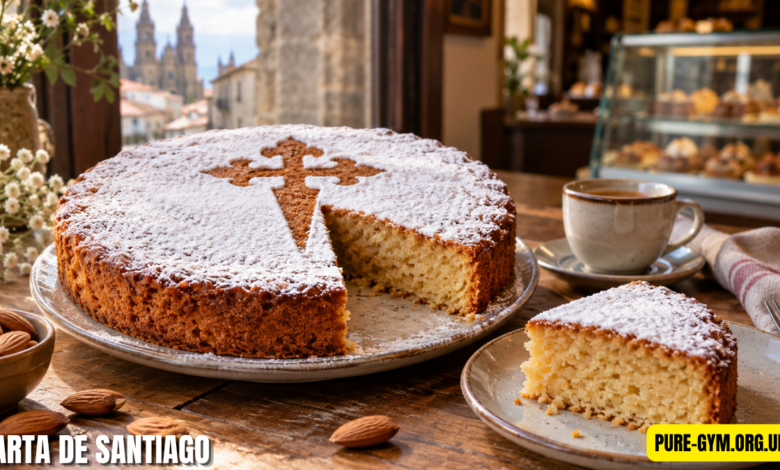
If you’re searching for the best tarta de Santiago near me, start with Spanish bakeries, Galician restaurants, tapas restaurants, and specialty European bakeries in your area. The best version should taste strongly of almonds, have a moist yet slightly grainy crumb, and usually arrive with powdered sugar and the distinctive Cross of Santiago on top.
Tarta de Santiago isn’t simply a generic almond cake. It is a traditional dessert from Galicia in northwestern Spain, with an officially defined version protected under a geographical indication. Knowing what the real cake is supposed to contain makes it much easier to judge local options rather than choosing whichever search result has the most attractive photo.
What Is Tarta de Santiago?
Tarta de Santiago is a traditional Galician almond cake built primarily around ground almonds, sugar, and eggs. Under the official Protected Geographical Indication specification, almonds must account for at least 33% of the cake mixture, sugar at least 33%, and eggs at least 25%. Lemon zest and small amounts of sweet wine, brandy, or orujo may also be used.
The protected version is round, golden inside, and finished with powdered sugar. The Cross of the Order of Santiago is traditionally left visible on the surface by placing a stencil over the cake before dusting it with sugar. Its expected texture is described as spongy and slightly granular rather than airy like an American layer cake.
There isn’t just one acceptable crust style, either. Official specifications recognize both a version without a pastry base and versions made with a thin shortcrust or puff-pastry base.
That distinction is useful when you’re shopping in the United States. A crustless cake isn’t automatically more authentic, and a cake with a base isn’t automatically wrong.
How to Find the Best Tarta de Santiago Near You
Because availability varies enormously by city, a good local search requires more than typing the dessert’s name into a map app.
Start with several searches rather than just one:
- “Tarta de Santiago near me”
- “Spanish bakery near me”
- “Galician restaurant near me”
- “Spanish desserts near me”
- “almond cake Spanish bakery”
- “Tarta de Santiago delivery”
Spanish restaurants are particularly worth checking because a bakery doesn’t need to specialize in Spanish food to sell almond cake, while a restaurant focused on regional Spanish cuisine is more likely to recognize the dessert by name.
Check menus directly after finding a promising place. Dessert selections often change, and a restaurant may serve Tarta de Santiago only on certain days or as a seasonal special. Calling before making a long trip is sensible when the online menu doesn’t confirm current availability.
What a Good Tarta de Santiago Should Look and Taste Like
Photos can help, but they shouldn’t be your only test.
Almond should be the dominant flavor
The cake shouldn’t taste mainly like vanilla, flour, frosting, or butter. Almond is the defining ingredient. Official descriptions specifically identify almond as its characteristic flavor and almond with egg yolk as its typical aroma.
Lemon zest can provide a little brightness. Cinnamon also appears in some traditional recipes, including the version published by Spain’s official tourism website.
The inside should stay moist
A good slice shouldn’t crumble into dry powder as soon as the fork touches it.
Ground almonds contain natural fat, which contributes richness and moisture. The Galician PGI guidance describes the finished texture as both spongy and granular, so expect something denser and more almond-forward than a standard sponge cake.
You want a tender interior with a recognizable almond texture, not a dry sheet cake disguised beneath powdered sugar.
Look for a golden interior
The outside is generally pale from powdered sugar, while the cut interior should be golden. That’s one of the characteristics included in the official product description.
Very dark edges aren’t necessarily a disaster, but an excessively browned or dry interior may suggest that the cake has been overbaked.
The Santiago cross is traditional, not just decoration
The powdered-sugar cross is one of the easiest visual clues.
Traditionally, a stencil of the Cross of the Order of Santiago is placed over the cake before powdered sugar is added. Removing the stencil leaves the darker cake visible in the shape of the cross. Spain’s official tourism recipe uses this same finishing method.
A bakery can still make an excellent almond cake without the design, of course, but a place specifically selling Tarta de Santiago will usually recognize the traditional presentation.
Questions Worth Asking the Bakery or Restaurant
When several nearby places offer the cake, a few simple questions can separate a serious version from a generic almond dessert.
Ask whether it is made in-house or brought in from another supplier. Neither answer automatically determines quality, but it tells you more about what you’re buying.
Then ask what the main ingredients are. Almonds, eggs, and sugar should be central to the recipe.
You can also ask:
- Is it crustless or made with a pastry base?
- Is lemon zest used?
- Is alcohol included in the recipe?
- Can I order a whole cake?
- Do you sell it by the slice?
- Does it need to be ordered ahead?
- Is today’s cake freshly made?
These questions are especially useful if you’re purchasing a whole cake for a birthday, dinner, holiday, or Spanish-themed gathering.
Crustless vs. Pastry-Based Tarta de Santiago
You may find noticeably different versions during your search.
A crustless Tarta de Santiago puts nearly all the attention on its almond filling. It can resemble a dense almond sponge or flourless almond cake.
The lined version adds either shortcrust or puff pastry underneath the almond mixture. Official Spanish specifications allow both styles, with the pastry portion limited in relation to the total cake.
Neither is universally “better.” If you love a concentrated almond texture, the crustless style may appeal more. If you prefer a contrast between tender filling and pastry, look for the lined version.
Don’t Assume Every Tarta de Santiago Is Gluten-Free
This is important if you’re avoiding gluten.
A crustless traditional recipe can be made mainly from almonds, sugar, and eggs without wheat flour. However, officially recognized versions may also have a shortcrust or puff-pastry base containing wheat flour.
Recipes and bakery practices also vary in the United States.
If you have celiac disease or a serious wheat allergy, don’t rely on the cake’s appearance or on a generic “almond cake” description. Ask the business about ingredients and cross-contact procedures directly.
Restaurant Slice or Whole Cake?
Ordering a slice first is a smart approach when you’re trying a bakery for the first time.
It lets you judge freshness, almond flavor, sweetness, and texture without committing to an entire cake. If the slice is moist, almond-forward, and balanced rather than overwhelmingly sugary, you can return for a full-size order.
A whole cake makes more sense when you’re already familiar with the bakery or need dessert for several people. Ask how far ahead the bakery needs the order, since smaller Spanish bakeries may produce specialty desserts only in limited batches.
What If Nobody Near You Sells It?
Tarta de Santiago is less common in many parts of the United States than churros, flan, or Basque cheesecake, so some searches will return very few local choices.
Expand your search from bakeries to Spanish restaurants, tapas bars, specialty food stores, and businesses importing Spanish foods. Searching nearby larger cities can also uncover options that don’t appear under a generic bakery search.
Another possibility is ordering from a bakery that ships nationally. Before ordering, check the ingredient list, shipping schedule, cake size, storage instructions, and whether the seller is shipping a freshly baked product or a shelf-stable packaged version.
And if local options remain poor, this is also a relatively straightforward Spanish dessert to make at home. Spain’s official tourism recipe uses ground almonds, eggs, sugar, lemon rind, cinnamon, and powdered sugar, with a pastry base in that particular version.
Frequently Asked Questions
What does Tarta de Santiago taste like?
Tarta de Santiago has a rich, sweet almond flavor with a moist, slightly granular texture. Lemon zest, cinnamon, or a small amount of sweet wine or brandy may add extra aroma depending on the recipe.
Is Tarta de Santiago the same as regular almond cake?
No. Tarta de Santiago is a specific Galician dessert traditionally centered on almonds, sugar, and eggs and associated with the Cross of Santiago decoration. A general almond cake can use very different ratios, flour, frosting, butter, or other ingredients.
Is Tarta de Santiago supposed to have a crust?
It can be made either way. The official specification recognizes both cakes without a base and versions with shortcrust or puff pastry underneath the almond filling.
Is Tarta de Santiago gluten-free?
Some versions can be, but you shouldn’t assume that every one is. Crustless recipes may contain no wheat flour, while pastry-based versions can contain wheat, and bakery cross-contact is another consideration for people who must strictly avoid gluten.
Where can I find Tarta de Santiago in the USA?
Start with Spanish bakeries, Galician or Spanish restaurants, tapas restaurants, specialty European bakeries, and Spanish food stores in your city. Search the exact dessert name first, then broaden the search and confirm availability directly with the business before visiting.
