Creatine is one of those supplements that seems almost too simple. You mix a small amount of powder into water, drink it and get on with your day. Yet once you start looking online, the advice quickly becomes confusing: should you load? Should you take it before training? Is 5g enough? Do you need to drink gallons of water? And what happens on rest days?
After spending the past six months paying close attention to how creatine fits around training, meals and ordinary routines, I’ve found that the best approach is far less complicated than social media often makes it sound.
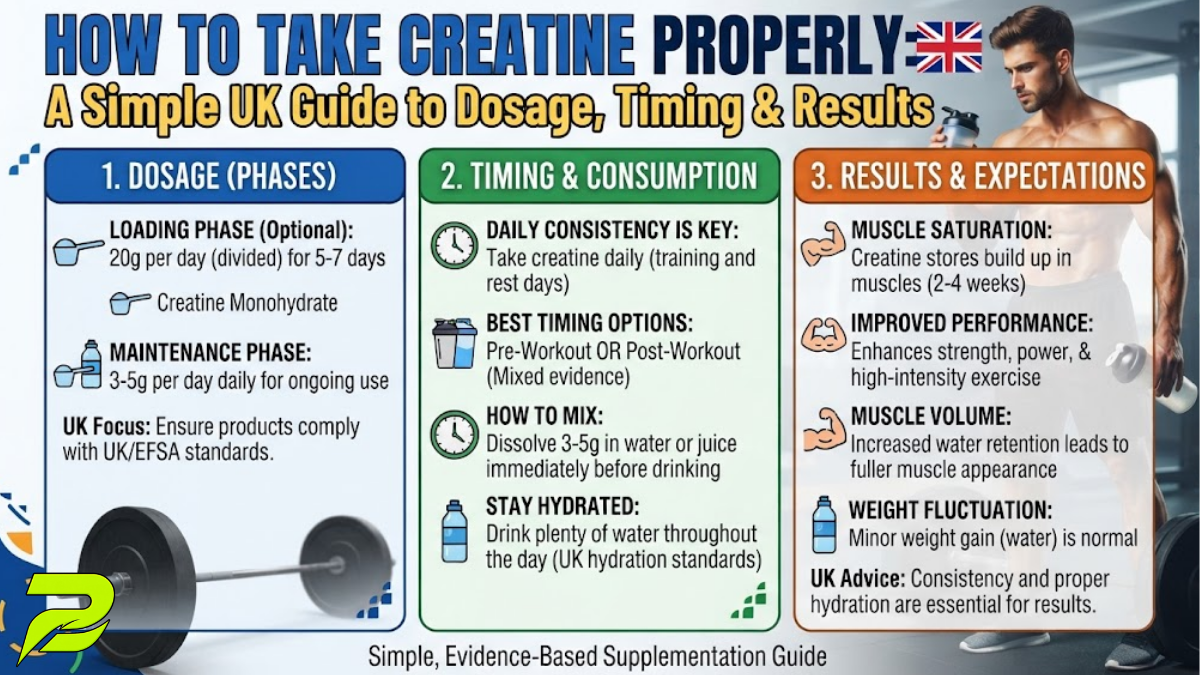
For most healthy adults, creatine monohydrate taken consistently at 3–5g a day is the straightforward option. You do not have to time it perfectly around your workout, and you do not need a loading phase unless you specifically want your muscle stores to rise more quickly. Research continues to support creatine, particularly when it is combined with resistance training.
This guide explains exactly how to take creatine, how much to use, whether to take it before or after the gym, what to do on rest days, how loading works, and the safety points worth knowing before you start.
Key Takeaways
- Creatine monohydrate is the best-studied form and is generally the sensible starting point.
- Most people can simply take 3–5g every day, including days when they do not train.
- A loading phase of around 20g a day, divided into smaller doses for 5–7 days, can saturate muscle creatine stores more quickly, but loading is optional.
- Taking creatine before, during or after your workout is less important than taking it consistently.
- You can mix it with water, a shake or another drink you already use.
- A little early weight gain can happen because creatine increases water stored within muscle.
- If you have kidney disease, are pregnant or breastfeeding, or take medicines that require kidney monitoring, speak to a GP or another qualified healthcare professional before supplementing.
What Is Creatine?
Creatine is a naturally occurring compound involved in the production of energy for short, intense efforts. Your body produces it naturally, while foods such as meat and fish also provide some creatine.
Supplementing increases the amount of creatine stored in skeletal muscle, helping to support the phosphocreatine system used to rapidly regenerate ATP during high-intensity activity. That is one reason creatine has become so popular with people doing weight training, sprinting and other repeated, explosive exercise.
It is not a steroid, and it does not work like a stimulant. You are not supposed to feel a sudden buzz after taking it.
The evidence is strongest around improving performance and supporting gains made alongside resistance training. Recent reviews have found improvements in several measures of strength and power when creatine is combined with exercise, although the size of the benefit varies between individuals and exercises.
Which Type of Creatine Should You Take?
For most people, I would keep this part boring: choose plain creatine monohydrate.
Creatine monohydrate is by far the most widely studied form. Other versions are often marketed as being more advanced, easier to absorb or superior for particular goals, but current evidence does not establish that these alternatives outperform monohydrate for increasing muscle creatine levels or improving exercise performance.
That matters because you can spend substantially more money on a fancy formulation without necessarily getting a better result.
In the UK, you’ll see creatine monohydrate sold by large sports-nutrition brands, supermarket supplement ranges and independent retailers. Prices vary considerably, but a basic powder is generally much more economical per serving than pre-mixed products, flavoured tubs or elaborate multi-ingredient blends.
When shopping, look for a product that clearly states creatine monohydrate and gives you a transparent amount per serving.
How Much Creatine Should You Take?
For a typical adult using creatine for gym training, 3–5g per day is a practical maintenance dose.
That is the bit I would focus on rather than trying to make your routine unnecessarily complicated. Scientific guidance commonly uses 3–5g daily after muscle stores have been saturated. A similar daily dose can also be used from the beginning without loading, although it takes longer to reach maximum muscle saturation.
For example, if you train at a gym in Manchester on Monday, Wednesday and Friday, you could take 5g on each training day and another 5g on Tuesday, Thursday, Saturday and Sunday.
There is no benefit in taking 20g on Monday simply because you have a hard leg session and then skipping it for several days.
Consistency matters far more than trying to match the dose to how hard the day’s workout feels.
Do You Need a Creatine Loading Phase?
No. You can take 3–5g a day without loading.
A loading phase is simply a faster way of filling your muscle creatine stores. A commonly used protocol is approximately 20g per day for 5–7 days, normally divided into four 5g portions, followed by 3–5g per day. Another approach scales loading to body weight at about 0.3g per kilogram per day.
The advantage is speed.
Without loading, daily doses of around 3–5g can take roughly three to four weeks to bring muscle creatine stores towards similar saturation levels.
So imagine you have booked a holiday to Spain and suddenly decide you want to start supplementing before your trip. A loading phase can get stores up more quickly. But if you simply want creatine as part of your long-term gym routine, there is little reason to rush.
Loading can also be less comfortable for some people. Large single doses may cause stomach upset, particularly when someone tries to swallow a large amount at once. Splitting the daily loading amount into smaller servings is therefore the more sensible approach.
When Is the Best Time to Take Creatine?
This is one of the questions people ask most often, and the answer is surprisingly relaxed.
There is no magic pre-workout minute for creatine.
You can take your daily serving before training, after training or at another convenient time. The key objective is maintaining regular supplementation so that your muscle stores remain elevated.
Personally, the easiest strategy is to attach creatine to something you already do every day. You might mix it into your post-gym protein shake, stir it into a drink with breakfast or simply have it after getting home from work.
That is often more useful than obsessing over whether 14:03 is better than 14:27.
For someone commuting by train from Birmingham to Manchester, for example, a complicated timing routine is more likely to be forgotten. A simple daily habit is easier to maintain.
Should You Take Creatine Before or After Your Workout?
Either is fine.
There has been plenty of debate around whether post-workout creatine is significantly better than pre-workout creatine, but the practical difference is much less important than simply taking the supplement consistently.
If your protein shake is already part of your post-training routine, adding your creatine there is perfectly reasonable.
Likewise, if you train first thing in the morning and prefer to take your supplements with breakfast afterwards, there is no strong practical reason to rearrange your entire routine.
Think of creatine as a daily supplement rather than an instant-performance pre-workout.
Can You Take Creatine on Rest Days?
Yes. Take creatine on rest days as well as training days.
Creatine works by increasing muscle stores rather than by providing a dramatic immediate effect from one individual serving.
Suppose you lift weights on Monday, Tuesday, Thursday and Saturday. You do not need to stop taking creatine on Wednesday, Friday and Sunday. Keeping the same daily habit makes it easier to maintain your routine and elevated muscle stores.
This is also one reason I prefer treating creatine like brushing your teeth rather than like a special training-day ritual.
What Should You Mix Creatine With?
Creatine monohydrate is versatile. You can mix it into water, milk, a protein shake or another drink.
There is no requirement to buy a special creatine beverage.
A post-workout shake can be particularly convenient because you are already consuming something and are unlikely to forget the serving.
You may also see claims that creatine must be taken with carbohydrates or sugar. While nutrient combinations can influence creatine uptake under some circumstances, there is no practical need for most gym-goers to consume a sugary drink solely to make their creatine “work”. Research does not support the idea that carbohydrate ingestion is essential for getting the muscle-building benefits of creatine.
If you like having creatine with a normal meal, that is absolutely fine.
Do You Need to Drink More Water?
You should stay properly hydrated, but you do not need to turn your day into a drinking competition.
The British Dietetic Association advises people exercising to start well hydrated, take appropriate fluids during activity and replace fluid lost through sweat afterwards. Their practical advice is to drink enough to stay ahead of thirst while avoiding both excessive and inadequate intake.
Creatine is sometimes blamed for causing dehydration, but the issue is more nuanced. Creatine draws water into muscle cells, which can contribute to an increase in body mass, but that is not the same thing as automatically becoming dehydrated.
On a hot August afternoon in London, Leeds or Cardiff, your fluid requirements will obviously be different from a cool January session in a local gym. Your exercise duration, sweat rate, weather and general diet all matter.
Don’t force yourself to drink litres upon litres simply because you started creatine.
Does Creatine Cause Weight Gain?
It can cause an increase in body weight, especially when you first begin using it.
That does not automatically mean you’ve gained body fat.
One of the expected effects of creatine supplementation is increased water stored within muscle, and this can push the number on the bathroom scales upwards. Weight gain is also listed among recognised considerations for creatine use.
Some research also suggests that creatine combined with resistance training can improve lean mass compared with resistance training alone. A 2024 meta-analysis found an average increase of around 1.14kg in lean body mass compared with resistance training alone across the included studies, although individual results varied.
So don’t panic if your scales move slightly after starting creatine.
Your waist measurement, photographs, gym performance and long-term trend can tell you much more than one isolated weigh-in.
What Happens If You Stop Taking Creatine?
You do not need to “cycle” creatine on and off simply because you’ve been using it for a few months.
When supplementation stops, muscle creatine levels gradually return towards baseline rather than disappearing overnight. Earlier research suggests this can take several weeks.
You might eventually notice a small change in body weight as some of the additional stored water decreases, but stopping creatine does not suddenly erase the muscle you’ve built through training and nutrition.
Is Creatine Safe?
For healthy adults using standard doses, the overall evidence is reassuring, but that does not mean creatine is appropriate for every person in every circumstance.
One reason the subject can become confusing is that creatine supplementation can increase blood creatinine levels. Creatinine is commonly used as part of kidney-function assessment, so someone taking creatine may see an altered laboratory result even when kidney filtration itself has not been meaningfully reduced. Recent systematic reviews found increases in serum creatinine without clear evidence of impaired kidney filtration in the studied populations.
That is still something worth telling your GP about, particularly if you are having blood tests.
If you already have kidney disease, you should not simply copy a gym influencer’s supplement routine. The NHS Specialist Pharmacy Service advises particular caution with creatine in people with kidney disease.
And if you are pregnant or breastfeeding, speak with your GP, midwife or another healthcare professional before taking supplements. NHS pregnancy guidance recommends checking supplement suitability with an appropriate healthcare professional.
The British Dietetic Association also recommends seeking advice from a suitably qualified professional when deciding whether sports supplements are appropriate.
What About Creatine for Vegetarians and Vegans?
This is an interesting area because dietary creatine mainly comes from animal foods, so people eating little or no meat may have lower baseline muscle creatine stores.
That does not mean everyone following a vegetarian or vegan diet needs creatine, but it is one reason supplementation may be particularly useful for some people in these groups.
The important point is to judge your overall diet and training programme rather than assuming a supplement can compensate for poor nutrition. The BDA emphasises that supplements should complement, not replace, a balanced diet.
How to Fit Creatine Into a Normal UK Routine
The best routine is usually the least glamorous one.
Imagine you leave home at 7:30am, catch the bus into town, work until five and head to the gym afterwards. You don’t need a separate “supplement schedule” taking over your evening.
Put your creatine next to something you already use every day. Your protein powder. Your cereal. Your shaker. Your kitchen cupboard.
Take 3–5g, mix it into your usual drink and carry on.
That matters because missing occasional doses isn’t a reason to panic, but building a habit makes long-term consistency much easier.
The same applies whether you train at a PureGym in London, a council leisure centre in Sheffield or a small independent gym in Glasgow. Creatine doesn’t know which postcode your gym is in.
A Practical Example of a Simple Creatine Routine
For someone who wants the simplest possible approach, a routine might look like this:
You wake up, have breakfast and get through your normal workday. After work, you travel to your local gym for a strength session. When you finish, you make your normal protein shake and add 5g of creatine monohydrate.
On your rest day, you still take 5g, perhaps with breakfast.
There is no need to double the dose because you trained particularly hard, and there is no need to stop it because you are having a Sunday roast.
The goal is boring consistency.
And with supplements, boring consistency is often exactly what you want.
Common Creatine Mistakes to Avoid
One common mistake is assuming more must be better. Taking huge doses indefinitely does not make sense simply because you want faster results.
Another is buying an expensive product because the packaging promises a more sophisticated form of creatine. Plain monohydrate remains the evidence-based benchmark.
I also wouldn’t obsess over timing. Missing the “perfect” post-workout window is not what makes or breaks your results.
And don’t neglect the basics. Creatine cannot rescue a poor training programme, inadequate protein intake, insufficient calories for your goal or a consistently poor night’s sleep.
The supplement sits on top of the fundamentals.
How Much Does Creatine Cost in the UK?
Prices vary by brand, flavour, retailer and tub size, so there is no single fixed UK price.
As a rough shopping example, a basic tub of creatine monohydrate might cost somewhere around £15–£30, while premium branded or flavoured products can cost more. Check the actual serving size rather than comparing tubs purely by their headline price.
A 500g tub taken at 5g per day contains roughly 100 servings. That makes it much easier to compare the true cost per day.
For a gym-goer watching their budget alongside train fares, food shopping and a monthly membership, plain unflavoured powder usually makes more financial sense than paying extra for elaborate blends.
Conclusion
Learning how to take creatine does not need to become a complicated science project.
For most healthy adults, the simplest approach is to use 3–5g of creatine monohydrate every day, including rest days. Take it whenever it fits naturally into your routine. A loading phase of around 20g a day divided into smaller servings for 5–7 days can speed up muscle saturation, but you can skip loading and still reach similar stores over time.
The biggest mistake is overthinking the details while ignoring the basics of training, food, hydration and recovery.
Make the habit easy. Measure your serving accurately. Choose straightforward creatine monohydrate. Tell your healthcare professional you’re using it if you’re having relevant blood tests, and seek individual advice if you have a medical condition or take medicines that require monitoring.
Used sensibly, creatine is one of the better-researched sports supplements available, particularly for people combining supplementation with resistance training.
Is 5g of creatine a day enough?
Yes, 5g a day is a standard maintenance dose for most adults. Taking it consistently can gradually increase muscle creatine stores without requiring a loading phase.
Should I take creatine before or after the gym?
Either is fine. Consistent daily intake matters more than trying to hit a particular pre- or post-workout window.
Do I need to load creatine?
No, loading is optional. You can use 3–5g daily from the start, although reaching full muscle saturation takes longer than with a loading protocol.
Can I take creatine on rest days?
Yes, take it on rest days too. Daily use helps maintain elevated muscle creatine stores, so there is no reason to restrict supplementation only to training days.
Can creatine damage your kidneys?
Current evidence does not show meaningful kidney impairment in healthy people using standard supplementation protocols, but creatine can raise blood creatinine levels. Anyone with kidney disease or relevant medical concerns should speak to a healthcare professional before using it.